
Support Academic Success from High School to University/College with a Psychoeducational Assessment
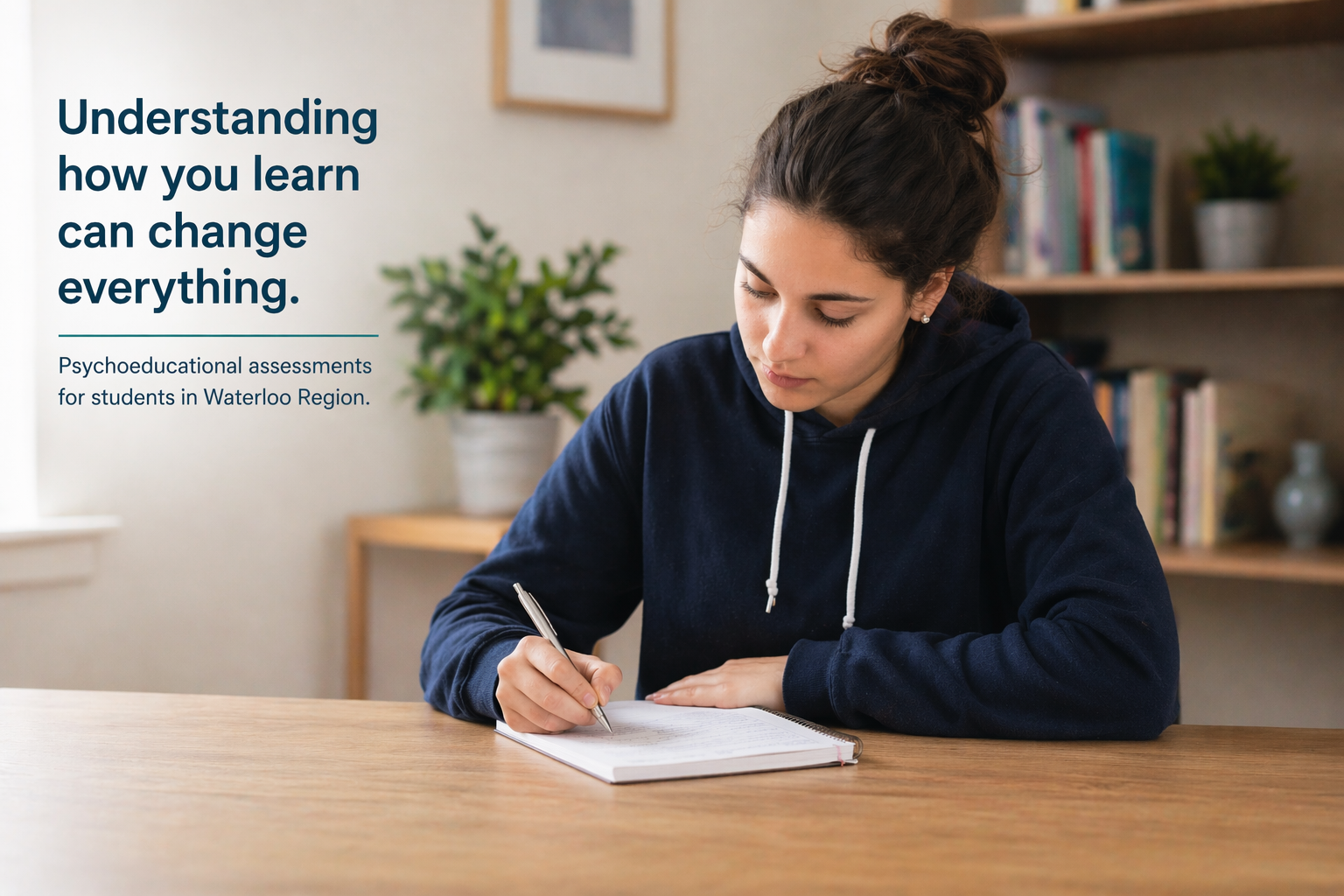
How a Psychoeducational Assessment Can Support Academic Success from High School to University
A practical guide for students and parents in Waterloo Region
If school has always felt harder than it “should,” the problem may not be effort.
Many bright, hardworking students struggle because the way they process information does not line up easily with the way school demands are delivered. Reading may take too long. Writing may feel slow and exhausting. Timed tests may seem unfair. A student may understand the material, but still have trouble organizing, remembering, or showing what they know.
A psychoeducational assessment can help explain why.
What is a psychoeducational assessment?
A psychoeducational assessment is a comprehensive evaluation of how a student learns. For older teens and postsecondary students, a strong assessment typically includes cognitive testing, information-processing measures, academic achievement testing, review of school and developmental history, and careful interpretation of how those findings affect real academic tasks.
In other words, the goal is not just to produce scores. The goal is to understand the student’s learning profile in a way that is meaningful, accurate, and useful.
Why students seek assessments in high school, college, and university
In high school, some students already have an IEP or have been identified by the school board as needing support. That can be very helpful, but it is not the same as a formal diagnosis.
That distinction becomes especially important when students move into college or university. In many postsecondary settings, an IEP on its own is not enough documentation for academic accommodations. Schools often want recent, comprehensive documentation that uses age-appropriate measures and clearly explains the student’s current functional limitations.
For many families, that is the point when a psychoeducational assessment becomes especially valuable: it helps bridge the gap between “We know school has been hard” and “We now have clear, current, professionally interpreted documentation and recommendations.”
How can an assessment help improve learning and academic success?
1) It helps explain why school feels harder than it should
A good assessment looks for patterns, not just isolated scores. A student might have strong reasoning skills but weaker processing speed. Another may understand lectures well but struggle with written expression, working memory, or reading fluency. Another may have significant attention or executive-function challenges that make planning, studying, and completing multi-step assignments much more difficult.
For students, that clarity can be a relief. For parents, it often replaces years of confusion with a more accurate and compassionate understanding.
2) It can support accommodations and access planning
A detailed psychoeducational report can help accessibility services understand a student’s disability-related barriers and consider accommodations that fit those barriers. At the same time, schools retain final decision-making authority, which is exactly why the quality of the report matters so much.
In practice, that means a strong assessment can make the conversation with accessibility services much more focused, efficient, and helpful.
3) It can make the transition to postsecondary smoother
A Grade 8 or Grade 10 assessment does not always capture how learning challenges show up later in a competitive adult learning environment. An up-to-date, comprehensive assessment gives the student and accessibility services the most accurate information about current strengths and challenges for support planning in college or university.
This is one reason many students seek reassessment shortly before or during postsecondary study.
4) It can clarify overlapping issues
Learning problems are not always caused by the same thing. Attention problems, anxiety, low mood, sleep disruption, medical issues, and learning disorders can overlap in ways that look similar on the surface.
That matters because the recommendations are only as good as the understanding behind them. A careful assessment helps identify what is most likely driving the student’s day-to-day academic difficulties.
5) It gives students a roadmap, not just a label
The best psychoeducational assessments do more than answer, “Is there a diagnosis?” They help answer, “What does this student do well?” “Where does learning break down?” and “What supports are most likely to help?”
That may include recommendations related to study strategy, note-taking, writing process, time management, assistive technology, or how to structure workload more effectively.
Why it matters who completes the assessment
Not all assessments are equally helpful.
When a report is incomplete, unclear, or poorly connected to real academic functioning, students can lose time, money, and momentum. Families often benefit from choosing an assessor who has strong expertise in psychological testing, differential diagnosis, and the academic accommodation process for older students.
Why many families prefer an expert, registered psychologist
In Ontario, both psychologists and psychological associates are regulated qualified professionals. For families choosing among qualified providers, doctoral-level psychologists and psychological associates can offer an added layer of depth because their training pathway typically includes advanced graduate preparation in assessment, diagnosis, research, supervised practica, and internship.
In practical terms, that extra training depth can be especially reassuring when the questions are complex, the history is layered, or the stakes are high for postsecondary planning.
When students are dealing with overlapping concerns such as learning difficulties, attention problems, anxiety, or burnout, a highly trained assessor can be especially valuable in helping families understand the full picture clearly and accurately.
When should a student consider a psychoeducational assessment?
a student is bright but consistently underperforming
homework, reading, or writing take far longer than expected
accommodations helped in high school, but the student now needs updated postsecondary documentation
an IEP explains part of the picture, but not enough for college or university planning
the student is working extremely hard and still cannot explain why school feels so exhausting
A final word for students and parents
Seeking an assessment is not about giving a student an excuse. It is about giving them an explanation.
When students understand how they learn, they are often better positioned to use the right supports, advocate for themselves, and approach school with more confidence and less self-blame. And when parents understand the “why” behind a student’s struggle, they can respond with more clarity, support, and direction.
At Waterloo Psychology Group, our goal is to provide a warm, supportive, science-informed assessment process that gives students and families clear answers, practical recommendations, and a better path forward.
If you would like to schedule an appointment with a registered psychologist for a psychoeducational assessment, we can help! Contact Waterloo Psychology Group through our website (www.waterloopsychologygroup.com) or call us at 226-476-0276.
226-476-0276